Why Armilar invested in mama health… …and a few insights on why pharma knows what patients do, but not why

The pharmaceutical industry runs on data, and it has to. Developing a drug takes approximately 10–15 years [1], yet the commercial launch window, the critical period where peak sales trajectories are established, is determined in the first six months post-approval. To make that time count, the industry spends more than €500 million per product on commercial launch activities [2]. It employs entire departments of analysts, it pays generously for the best data vendors on the market, and yet, in therapeutic areas where multiple comparable drugs compete, 60% of launches still fail to meet prelaunch expectations [3].
This failure rate is rarely due to the clinical efficacy of the molecule itself. Rather, it stems from an “insight gap” regarding the real-world environment in which the drug is used, especially for large Pharma companies [4].

Incomplete understanding of the market and customer needs is one of the major reasons pharma companies fail to meet launch expectations, particularly among large pharmaceutical companies [5].
Commercial teams struggle to answer fundamental behavioral questions: “Why do patients delay visiting a specialist for eight months? What specific side effect triggers discontinuation of a therapy after three weeks? Why do patients prefer a competitor’s less effective drug?”
This is not a new problem brought about by recent trends. It is a structural deficit that has always been embedded in how the industry is organised. Unlike virtually every other consumer-facing industry, pharma does not sell directly to the people who use its products. Between the manufacturer and the patient sits a dense intermediary stack: prescribing physicians, pharmacists, insurers, hospital formularies, and pharmacy benefit managers, each filtering and mediating the relationship. On top of that, regulatory and compliance constraints sharply limit the ways in which pharma companies can interact directly with patients — rules designed to protect patients from undue influence, but which have the side effect of keeping manufacturers structurally distant from the very people their drugs are meant to serve. The result is that pharma has always operated with a fundamental opacity toward its end customer: able to map the market through intermediary data, but unable to hear the patient’s own voice directly and systematically.
Additionally, the industry’s shift toward specialty care, rare diseases, and precision medicine has raised the stakes considerably. The era of the “blockbuster” primary care drug, where a single molecule could be marketed to millions with a broad brush, and where the sheer scale of the patient population absorbed a great deal of commercial imprecision, is fading. Smaller patient populations, more complex biology, longer diagnosis pathways, and higher barriers to adoption mean that every commercial decision carries more weight [5]. The structural blind spot that was always present has become, in the current environment, genuinely expensive.
That is the gap Mama Health is closing. And it is why Armilar co-led their Series A.
The data that pharma has, and the data it doesn’t
To understand why this gap exists, it helps to understand how pharmaceutical commercial intelligence actually works today.
The foundation of modern pharma data is quantitative claims data. Vendors like IQVIA and Komodo Health map hundreds of millions of patient lives through insurance claims, electronic health records, and lab results. These are genuinely impressive datasets that can help you reconstruct a patient’s treatment journey with a high degree of accuracy.
What’s difficult to see is the why.
A claims record shows that a patient abandoned a prescription after three weeks. It cannot tell you whether that happened because of a side effect, a cost issue, a conversation with a family member, or simple forgetfulness. It can show that a patient waited eight months between the first symptom and the specialist visit. It cannot tell you whether that delay reflected fear, lack of awareness, difficulty accessing care, or the specific way the disease presented. The dataset captures what happened, but it is silent on why.
Even significantly better analytics tools cannot address this issue. The absence seems structural: behavioral motivation simply isn’t encoded in claims data.
Why existing solutions haven’t solved it
The industry has not ignored this problem. Three categories of solution have emerged to fill the qualitative void (and all three fall short):
Traditional market research (focus groups, structured interviews, patient surveys) remains the historical standard for gathering qualitative insight. The limitations are well-understood: these exercises take months to run, they are (very!) expensive, and the resulting report is a static snapshot of patient sentiment at one point in time. By the time the analysis reaches the strategy team, it may already reflect a world that no longer exists. Sample sizes are small by necessity, which limits statistical confidence and makes it hard to segment findings by cohort or sub-region. And in many cases, the interviews are conducted with physicians rather than patients directly, a proxy that introduces its own layer of interpretation and distance from the actual patient experience.
Social listening (scraping Reddit, Twitter/X, and patient forums) offers a faster, cheaper alternative. But a forum post is a moment, not a history. It captures what a patient chose to share on a particular day, stripped of everything that gives it meaning: what treatments they had tried before, what had failed and why, what comorbidities shaped their experience, how their condition had evolved over time. There is no longitudinal thread, no structured profile, no way to ask a follow-up question. The insight is real, but it is decontextualised. And decontextualised patient data is of limited use to a commercial team trying to understand why a therapy is or isn’t working across a population. And, of course, online health communities typically over-represent the most extreme experiences: the patients who are either very satisfied or very angry. The typical patient, whose experience is quieter and more ambiguous, is often invisible.
Traditional patient engagement platforms (apps and portals that aggregate patient-reported outcomes) are a closer analogue to what mama health does, but they rely on passive data collection: structured forms, PRO questionnaires, symptom trackers. The data they produce reflects what patients are willing to report in a form, not the full texture of their experience. Completion rates are low, and depth is limited.
What’s missing is a way to have a real conversation with patients, at scale, and convert that conversation into data that commercial teams can actually act on.
Enter mama health
Mama health was founded in Berlin in 2022. Its product has two layers that work together.
The first is a patient-facing app for people living with chronic and rare conditions. When a patient joins, instead of being asked to complete a form, an AI system conducts a structured conversation to explore the patient’s diagnostic journey, symptoms, treatment history, and day-to-day experience living with the condition. The AI adapts as it goes: if a patient mentions joint pain, it asks whether it’s worse in the morning or evening. If they mention fatigue, it explores the impact on their work life, their sleep, their relationships. The conversation is natural, contextual, and probing in ways that a static questionnaire never is.
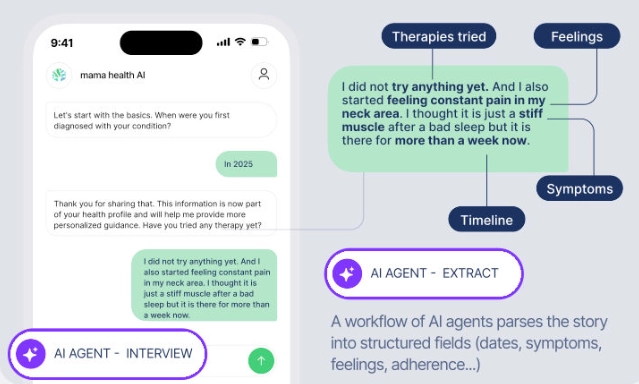
The second layer is an analytics platform for pharma commercial teams. A pipeline of specialized AI agents converts those natural-language conversations into structured data: timestamps, symptom classifications, specific side effects, treatment adherence levels, referral pathways, emotional context, etc. The result feeds a live dashboard that teams can use to understand what’s actually happening in the real world with their patient populations.

The output is a continuously updated intelligence resource instead of a static report. Teams can map the average time from symptom onset to diagnosis (e.g., in one Psoriasis dataset the company has built, that figure is 8.2 months). They can trace referral pathways. They can filter by cohort and pull specific breakdowns of unmet needs. The analogy mama health uses is the Bloomberg Terminal: always on, always current, built for decisions, not presentations.
The “give to get” model is thoughtfully designed. Patients receive genuine value from the platform: personalized guidance drawn from peer experiences and a medical literature base of over one million research papers. That value exchange is what drives engagement and, critically, data quality.
The traction and the team behind it
The Analytics Platform launched commercially in Q2 2024. In under two years, the company signed contracts with several of the world’s leading global pharma organizations across multiple therapeutic areas.
The “land and expand” pattern is working: clients that started with a single brand have expanded into additional therapeutic areas within their organizations. The company moves brand-by-brand inside large pharma organizations, which creates some friction in the sales motion but also creates compounding account value over time.
The feedback we heard from those clients, more than about features, was about outcomes: access to patient insights that traditional research methods couldn’t deliver at comparable speed or cost, and a genuine willingness to expand usage across teams. In a segment where data vendors are evaluated by sophisticated procurement committees with long memories, that kind of early signal carries real weight.
On the patient side, the app has onboarded thousands of patients across a growing number of chronic conditions, with average patient engagement one order of magnitude above typical digital health benchmarks. Quite impressive.
The Founders have a strong market fit. CEO Mattia Marco Caruson spent years at Kearney advising Big Pharma on rare-disease commercial strategy, having sat in the rooms where launch decisions are made and understanding firsthand what commercial teams are missing. That direct experience shapes every product decision. The COO, Jonas Witt, is a medical doctor with a background in neuroscience and experience in digital health, bringing the clinical expertise and compliance rigor required for a platform that manages patient interactions at scale.
More recent additions have further strengthened the team’s technical and operational capabilities: Johannes Unruh, former co-founder of a legal-tech startup, joined as CTO; Lorenzo Famiglini, a PhD in AI for Health, serves as Chief AI Officer; and Luca Bandi, formerly with Credit Suisse and Finance Director of a radiology startup, leads finance. Beyond the leadership team, we were impressed during our due diligence by the depth and quality of both senior and junior talent across the organization.
Why we invested
We had been tracking the real-world evidence and patient intelligence spaces for some time, and the same question kept surfacing: why does this gap still exist? Pharma has no shortage of data vendors, consultancies, or technology investment. And yet the behavioral layer — the systematic, scalable capture of why patients do what they do — remained unsolved. The answer, we came to believe, is that solving it requires building two hard things simultaneously: a consumer product that earns genuine patient engagement, and an enterprise data product that translates that engagement into something pharma commercial teams can actually use. Most companies that try pick one and fail at the other.

When we met Mattia and Jonas, a few things became clear that shaped our conviction.
- The conversation is the data. This distinction matters more than it first appears. IQVIA, for instance, processes data that already exists in the world (insurance claims, EHR records, etc.) and organizes it. Mama health’s AI generates primary source data that would not otherwise exist: the patient’s own account of their experience, captured in real time, structured through a probing conversation. The AI isn’t layered on top of the data collection; it is the data collection. That means the quality of the underlying asset is bounded only by how well the AI can conduct an interview — a ceiling that improves with every model generation and every iteration of the conversation design. Traditional research platforms can adopt better analytics tools, but they can’t adopt this architecture without rebuilding from the ground up.
- Rare disease registries are not replicable on a short timeline. The instinct in data businesses is to assume that a well-funded competitor can catch up by moving fast. In rare disease patient registries, that assumption breaks down. Finding, enrolling, and retaining verified patients with conditions that affect small, dispersed populations takes time. The data has to be built patient by patient, condition by condition. CorEvitas understood this: Thermo Fisher paid $912 million for it in 2023, not for its technology but mostly for its registries — patient cohorts that had taken years to assemble and couldn’t be reconstituted quickly. Mama health is building the equivalent for the behavioral and experiential layer, across multiple chronic conditions simultaneously.
- The market is large and moving in their direction. The global life science analytics market was valued at approximately USD 11.4 billion in 2025 and is growing at 7.5% annually [6]. The broader commercial pharmaceutical analytics market, where mama health’s platform competes for budget, was valued at USD 29 billion in 2024 and is projected to grow significantly over the next decade [7]. More importantly, regulatory momentum — the FDA and EMA’s increasing emphasis on patient-reported outcomes for labelling and reimbursement decisions — is making mama health’s data type progressively more valuable, not less.
- The expansion pattern within accounts is the clearest product-market fit signal. The most telling evidence is what happens after the first contract: clients that started with a single brand have come back to expand into additional therapeutic areas within their organizations. In pharma, that means a team that bought a licence, got results meaningful enough to justify internally, navigated procurement again, and signed a new contract. That process doesn’t happen for a tool that is merely adequate; it happens for a product that delivers enough visible value that internal champions are willing to stake their credibility on expanding it.
- The acquirer universe is large and motivated. Flatiron structured unstructured oncology data for pharma and sold to Roche for $1.9 billion. CorEvitas built longitudinal patient registries and sold to Thermo Fisher for $912 million. Both exits were driven by the same underlying logic: proprietary patient-level data with a structured, queryable architecture commands a premium that generic analytics tools do not. IQVIA, Norstella, and the major CROs are all missing the behavioral and experiential layer that mama health is building. They know it. The strategic rationale for acquisition doesn’t require a market to mature further, it’s already present.
The challenges ahead
The bar is high. The risks are real, and, as usual, we’ve addressed them as part of the investment case.
Selling into large pharmaceutical organizations takes time, and mama health’s brand-by-brand motion means the path to enterprise-wide adoption runs through internal champions rather than a single procurement decision, even when a Master Services Agreement is in place. Sometimes that creates a longer ramp, but it also creates something valuable: a pattern of expanding relationships with clients who have chosen to deepen the engagement on their own terms. Scaling the go-to-market beyond the founding team is the next step, and it is a central use of the Series A capital.
Patient retention through the web app sits well above industry benchmarks, and the team has made meaningful improvements in cost-per-acquisition. Deepening engagement further is a clear product priority, and a meaningful part of the roadmap is focused on exactly this, not as a remediation effort, but as the next lever for compounding the data quality that makes the commercial product valuable.
And the broader risk common to any data business: a well-resourced competitor (for instance, a large CRO, a pharma data incumbent) could attempt to build a similar patient interface. That risk is real, but our conviction is that the temporal moat is more durable than it first appears. Longitudinal patient registries in rare diseases, built patient-by-patient over years, are not quickly replicated. Mama health is already operating across 20 countries, each with its own regulatory environment, patient communities and healthcare system, a footprint that a new entrant would have to rebuild from scratch. Workflow integration at major pharma accounts is not easily displaced once it is in place. The feedback loop between patient data quality and commercial product value means the product gets better the longer it runs for any given client.
Behind this investment sits a broader conviction. Pharma has spent decades building extraordinary tools for understanding what happens biologically inside a patient. It has spent almost nothing building tools to understand what happens experientially — how a disease reshapes a person’s life, what drives them toward or away from treatment, what they actually need that the current system isn’t providing. That is a strange gap, given that the entire commercial case for a drug depends on patients choosing to start it, stay on it, and speak well of it to their doctors.
Mama health is the first company we have seen that approaches this problem with the right technical architecture and the right founding team to build it to scale. We think it can become the category-defining patient intelligence platform in pharma commercial analytics. And we are genuinely glad to be part of that build alongside Mattia, Jonas, and the rest of the team.
Authored by Pedro Castel-Branco, Principal at Armilar
References
[1] McKinsey & Company (2023). “Fast to first-in-human: Getting new medicines to patients more quickly.” https://www.mckinsey.com/industries/life-sciences/our-insights/fast-to-first-in-human-getting-new-medicines-to-patients-more-quickly
[2] MassBio (2024). “Launch Costs: Spend Wisely Pre-Launch and Post-Launch Analysis.” https://www.massbio.org/news/member-news/launch-costs-spend-wisely-pre-launch-and-post-launch-analysis/
[3] McKinsey & Company (2024). “Developing pharmaceutical launch leaders and company-wide capabilities at scale.” https://www.mckinsey.com/industries/life-sciences/our-insights/developing-pharmaceutical-launch-leaders-and-company-wide-capabilities-at-scale
[4] Deloitte (2023). “Drug launches reflect overall company performance.” https://www.deloitte.com/us/en/insights/industry/health-care/key-factors-for-successful-drug-launch.html
[5] IQVIA (2025). “Global Trends in R&D 2025”.
[6] Grand View Research (2025). “Life Science Analytics Market” https://www.precedenceresearch.com/real-world-evidence-solutions-market
[7] Research Nester (2026). “Commercial Pharmaceutical Analytics Market Outlook.” https://www.researchnester.com/reports/commercial-pharmaceutical-analytics-market/2834