Why Armilar invested in MITO AI... and the shift from video generation to programmable production
In March 2026, OpenAI announced it was shutting down Sora. The consumer app went dark on 26 April, barely seven months after a launch billed as the moment Hollywood got disrupted, and roughly three months after Disney’s headline commitment fizzled without a signed deal.The API, followed last month.
It is worth sitting with that. The most capitalised research lab in the world, with the best distribution in consumer AI and a genuinely excellent model, could not make consumer video generation pencil out. Downloads peaked and collapsed. Monthly in-app revenue never cleared seven figures against compute costs an order of magnitude higher. The problem was never output quality. The problem was that generating video is expensive, that impressed users are not paying users, and that a clip is not a product.
We read that shutdown as the most instructive event in this market, and not a bearish one. It is a sorting signal. It tells you where value in generative video is not going to accumulate: in the undifferentiated act of turning a prompt into a shot. That capability is deflating toward the price of compute, with four or five well-funded labs racing each other down the curve.
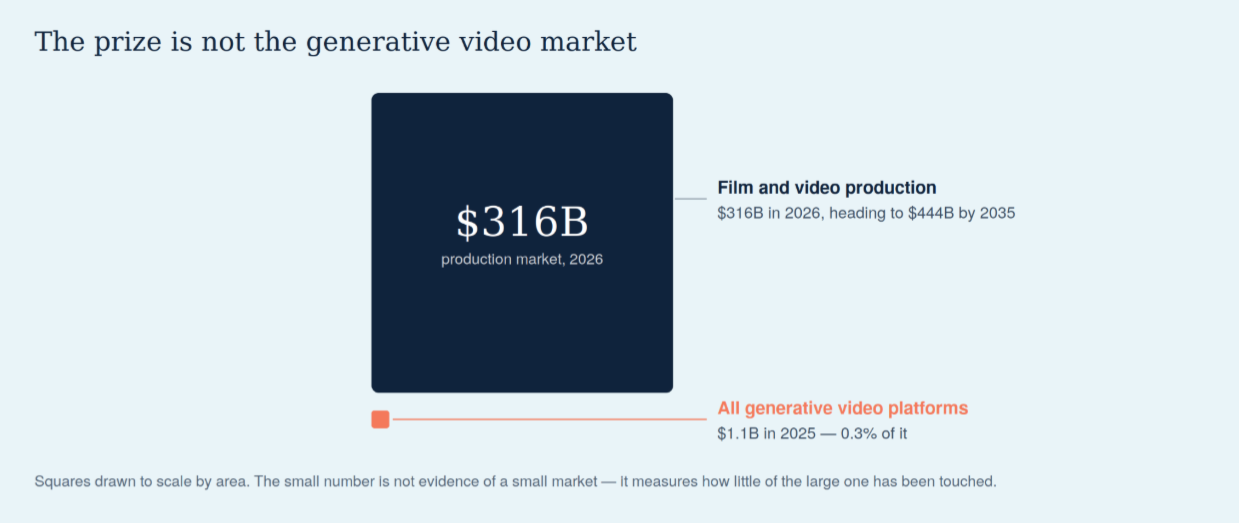
It also points at a second, larger misreading. The generative video market is usually sized by its own revenue on the order of $1.1B across all platforms in 2025 and that number gets used to argue the category is small. We think it argues the opposite. It is the measure of a capability that has barely begun to touch what sits next to it: a global film and video production market worth roughly $316B in 2026 and projected to approach $444B by 2035, almost all of which is labour, logistics and time, and almost none of which is software.
In almost everything software has touched, unit costs fall over time, and demand expands to fill the space that creates. Professional audiovisual production never joined that pattern, because its core input is not compute but crew-hours and physical presence and those do not get cheaper when technology improves. The interesting question is therefore not which model wins. It is what happens to $300B+ of spend when that changes.
Demand is moving the same way. Video is already how most people are informed, sold to and persuaded, and other formats keep losing ground to it in nearly every channel that matters commercially and that gap widens as intelligence gets cheap, more of the work gets automated. Video is becoming the default format for almost everything at the same moment the cost of producing it falls. MITO sits where those two curves meet.
Phase 1 towards restructuring production… understanding why it stayed manual
It is tempting to assume audiovisual production resisted software because the industry is conservative. That is not the reason. The reason is structural, and it explains precisely where the disruption lands.
Software already conquered half of this pipeline. Editing, colour grading, compositing, sound design and distribution were digitised decades ago, and the tools that did it: Avid, Premiere, After Effects, Resolve became large, durable businesses. What software never touched was acquisition: the act of getting the image in the first place.
Acquisition stayed manual because it was governed by physics rather than by information. To obtain a shot you needed a place that exists, a light source that exists, a person who exists, and a lens pointed at all three. No amount of computation removed any of those requirements. The cost curve of production flattened at exactly the point where the physical world began.
That produced the defining economics of the industry:
· Cost scales with ambition, not with volume. A more ambitious shot costs more, always. There is no version of this business where the tenth shot is cheaper than the first.
· Iteration is prohibitively expensive. Because acquisition is physical, changing a decision late means re-acquiring it. A client note asking for warmer light in scene four means the location, the crew and the talent must exist in the same room again. This is why approval chains in advertising are so heavy: they exist to prevent late changes, not to enable them.
· Access is capital-gated. Only organisations that can front the acquisition cost can produce at broadcast quality. This is why “professional production” and “well-funded” have been synonyms for a century.
Phase 2 towards restructuring production… what generative models actually changed
Generative video models broke the acquisition constraint. That is the whole of what they did, and it is enormous.
For the first time, an image that does not exist can be obtained at the marginal cost of compute rather than the marginal cost of a crew. The three economics above invert. Ambition stops being priced in euros per shot. Iteration becomes cheap. Access decouples from capital.
But breaking the acquisition constraint does not, by itself, produce a deliverable and this is the distinction on which this concrete investment case rests.
A finished piece of professional content is not only a set of images. It is a system: continuity that holds a character consistent from scene one to scene fourteen; brand rules that survive across every asset in a campaign; a review chain that lets a creative director comment, request and approve; version history that explains why a decision was made; and rights provenance a legal team can sign. None of that is produced by a model. All of it is produced by a workflow.
So the industry now has an inverted problem. Acquisition, historically the expensive and constrained part, is becoming cheap and abundant. Everything around acquisition organised for a century around the assumption that images are scarce and expensive is now the bottleneck.
Most tools haven’t caught up. Prompting and regenerating is fine for exploring, but it won’t get you a deliverable a client can sign, because the tool remembers nothing between one generation and the next. The brief, the brand book, the character you established in scene two, the notes your client sent on Friday none of it lives in the tool. It lives in someone’s head, or in an inbox.

The difference between a prompt box and a persistent creative canvas is the difference between a feature and a system of record. Features get absorbed by whoever has the best model. Systems of record accumulate the customer’s own context and become progressively harder to leave.
Phase 3 towards restructuring production… why this market is interesting under every scenario
Much of the debate in this category thus far has been about which model wins. We think that matters less than it seems, because the opportunity looks the same either way. Consider the two scenarios, and note that they lead to the same place. If model quality plateaus, generation becomes a commodity input bought from several interchangeable suppliers, exactly as cloud compute did. Value accrues to whoever owns the workflow that guides customer’s work. The orchestration and control layer wins.
If model quality keeps compounding, the volume of professional content produced rises by an order of magnitude, because the binding constraint on how much video the world makes has always been the cost of making it. A hundredfold increase in output creates a management problem continuity, brand governance, approvals, rights that scales faster than the generation problem itself. The orchestration and control layer wins, harder.
There is no third scenario in which the layer that manages the work becomes less valuable. That is an unusually comfortable position from which to underwrite a fast-moving category: we do not need to be right about the models to be right about where the value settles.
Which brings us to the company.
Reimagining the production stack and so enters MITO AI
MITO AI was founded in 2025 by Iñaki Berenguer, Arantxa Barcia and Danny Saltaren, with teams in Madrid and San Francisco. The platform launched publicly in January 2026 alongside a $4.5M round led by Lightspeed, Kibo Ventures, Kfund, Everywhere Ventures, LifeX and scouts from Sequoia and a16z.
MITO’s premise is that AI should not replace the director, only the hours. Humans direct and keep creative control; agents absorb the work that eats time without needing judgment. Their product is built in three layers.

A - The Canvas Layer. An infinite collaborative workspace, closer in spirit to Figma than to a chat window, holding the entire project in a persistent state: brief, context-aware moodboards, scene-based storyboards, shot graph, versions, comments and client review pages. Because the canvas holds the project, a shot can be regenerated without losing continuity with the shots around it, and a brand’s rules are inherited by every generation rather than retyped into every prompt.
B - The Orchestration Layer. A single interface routing across foundation models: Veo, Kling, Seedance, Nano Banana, ElevenLabs and others — for video, image and audio. The strategic function of this layer is to make model choice a runtime decision rather than a company-defining bet. As the frontier moves, the customer’s workflow does not.
C- The Control Layer. The proprietary component, and the one that determines how much of the value MITO retains. This is where character consistency, continuity, brand adherence and style transfer are enforced by models trained on real production output rather than requested politely in a prompt. It is the layer that turns a set of generated images into something a client can sign.
Layer C is why MITO runs two businesses rather than one. MITO Tools is the platform. MITO Films is the company’s own AI-native production studio, delivering paid client work under real deadlines. The studio is not a side project or a marketing exercise: it is the source of the production data and the workflow knowledge that layer C is built from. Films generates it, the Tools productises it, and the loop compounds.
The company has been building deliberately toward that layer. In June 2026 it acquired kluster.ai, a team that had spent a year on the problem of making AI-generated output trustworthy starting with code, verifying generated work against bugs, regressions and intent mismatch. That is the same problem in a harder medium: as video becomes programmable and adaptable across users, languages and formats, the binding question stops being “can the model render this?” and becomes “can we guarantee this render matches intent, brand and continuity, at volume, without a human inspecting every frame?”. kluster.ai’s founder, Julio Viera, joined as CTO, bringing the infrastructure and model-training capability that turns layer C from a roadmap item into a build.

The team
We have looked at some companies in this category. Most are in one of two shapes: strong technically and naive about how production works, or creatively fluent and unable to build. MITO is neither, and that is a function of who founded it.
Iñaki Berenguer (co-founder and CEO) has built and exited three companies: Pixable, acquired by SingTel; Contactive, acquired by Fuze; and CoverWallet, acquired by Aon for around $300M in under four years. Very few founders in Europe share his tier of success, and that elite track record acts as a massive shortcut for B2B sales. When selling to large enterprise brands with complex procurement and legal hurdles, his unparalleled operational history is exactly why their commercial motion is gaining traction this early.
The co-founding team is also stellar. Danny Saltaren (co-founder and CPO) won Spain’s Premio Nacional de Diseño in 2021, founded two studios before this, and was Head of Product Design at two unicorns. He has built the harder half of the product: a canvas that holds a brief, a shot graph, a version history and a model router in one logic a director can read in ninety seconds. Arantxa Barcia (co-founder and CCO) is an art director and filmmaker who leads creative direction at MITO Films using the tool to serve plenty of clients. Julio Viera joined as CTO bringing engineering excellence and the verification infrastructure layer that the product runs on; he co-founded Contactive with Iñaki and was VP of Engineering at Pixable, making MITO their third company together.
Shipped, not pitched
MITO Films has delivered video productions for Movistar, Telefónica Tech, Zara, Repsol and Dellafuente. The clearest example is Batido, the Movistar campaign around the Spanish football squad announcement in May 2026, created by Oriol Villar and produced by MITO AI, which ran on television, in cinemas, outdoors, in press and online.
The detail we keep coming back to is that more than 140 technical and creative professionals worked on it.
One person, one prompt, one film…That is just not how it goes when the work has to air on national television. It still takes a large crew; they are just working with different instruments now. This is a workflow market rather than a replacement market, and workflow markets are bigger, stickier and harder to displace.
It is also why we are comfortable with the roadmap. MITO has been running its own platform against real client deadlines and real approval chains since before it sold that platform to anyone.
Joining the journey
Audiovisual production has spent a century as one of the most manual, capital-intensive, and least software-defined creative industries in the world. It is now acquiring a cost curve for the first time. We believe the companies that matter in this transition will not be the ones generating the most striking single clips, but those that own the systems professional teams actually work inside. While this space is still in its infancy and the execution risk of building an industry standard on shifting technological ground is incredibly high, we think MITO is building exactly the right foundation. They are led by a team that proved they could deliver the work long before they sold the tool.
At Armilar we look for companies that redefine how an industry works, not just what it can produce. MITO pairs a clear thesis on the future of audiovisual production with a founding team that has already delivered for some of the most demanding brands in Europe and the execution capability to turn that into a platform. We are proud to back them from Fund IV.
We are thrilled to join Iñaki, Arantxa, Danny, Julio and the whole MITO team on this journey.
Authored by Darío Villena, Principal, Armilar Venture Partners