Why Armilar invested in FRANK…and a few insights on giving insurance brokers back the time to advise and protect their clients

… and a few insights on giving insurance brokers back the time to advise and protect their clients
credit Gemini
Picture this:
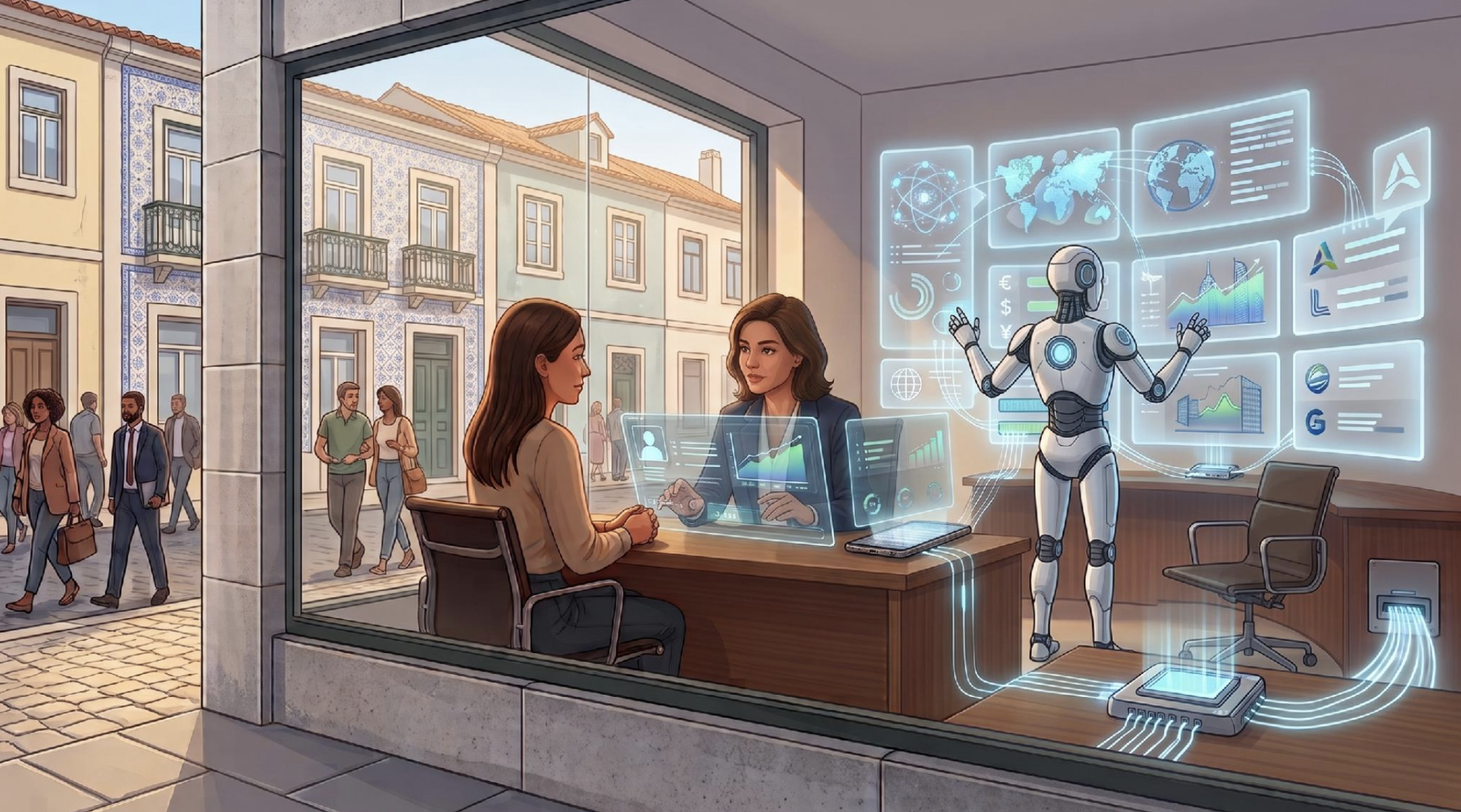
On a Monday morning, in an insurance agency in a mid-sized Portuguese town, a client sends a WhatsApp message: a photo of her new car’s registration document and a request for the best motor insurance available. A simple question. The agency has been doing this for twenty years, and the broker knows the products by heart.
Yet by lunchtime the client still has no answer. The broker has not been idle; she has been busy all morning. So where did the time go?
Behind the counter, she opened the portal of the first insurer, logged in and re-typed the client’s data into its forms. Then the second insurer, with a different login, different fields and different rules. Then a third, a fourth, a fifth. In between, two more emails arrived: a claim stuck for a week, and a change of address that has to be updated in every insurer’s system where that client holds a policy…
This may read like an exaggeration, but it is an ordinary day. FRANK estimates that a single motor quote across four to six carriers takes around 30 minutes by hand, and brokers have told the company that back-office work can take up to 80% of their day. The part of the job brokers exist for, advising clients on risk, gets whatever time is left.

Two worlds that were never designed to talk to each other…
Insurance distribution rests on a triangle: the insurer, the broker and the client. For decades, each insurer built its own systems for its own products and processes and opened a web portal as the broker’s window into them. Brokers, in turn, run their own CRM or ERP to manage clients and policies. The broker became the human bridge between the two, carrying data by hand from one system to the other.
Why has this lasted? First, because the channel works: clients still want someone to call when something goes wrong, and agents and brokers remain central to insurance distribution. Second, because the fragmentation is structural. To get a sense of scale, take a deliberately simple example: just 10 processes, across 20 carriers and 25 products in Portugal, already makes 5,000 possible combinations, and a broker handles far more than 10 processes. Every new country multiplies that again.
But the tide is turning. Brokers face more regulatory and insurer complexity every year, clients expect answers in minutes, and recent advances in agentic AI have made it possible to run end-to-end tasks in production, with a human validating the result.
So the question is not whether brokers need automation. It is which kind of automation can survive this fragmentation.
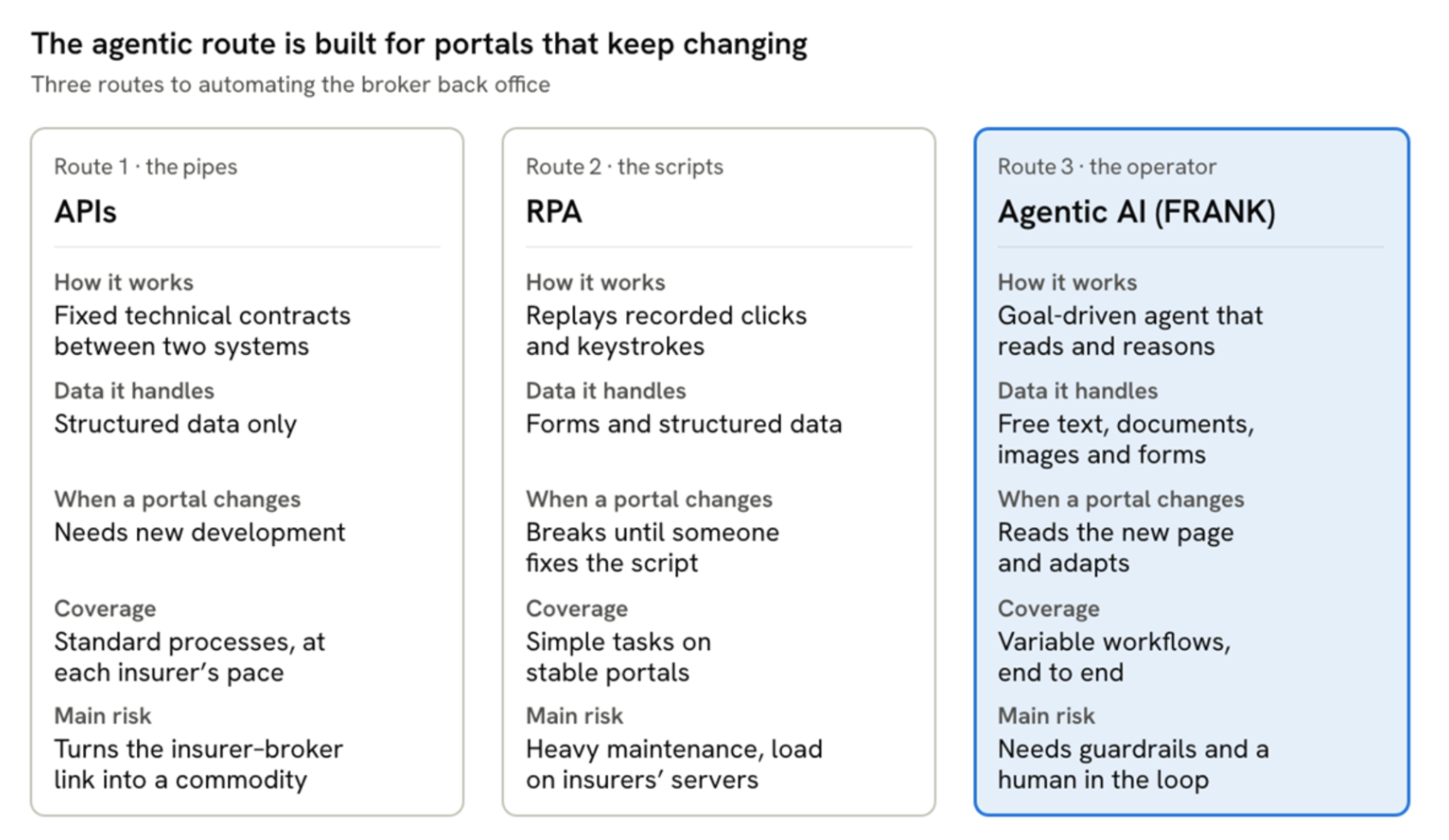
There are three routes:
Route 1 — APIs
The textbook answer is APIs (application programming interfaces): the insurer exposes a programmatic door into its systems, and the broker’s software talks to it directly. Where they exist and work, APIs are fast and reliable.
The problem is coverage. APIs tend to cover structured, standard processes such as quotes, issuance and document retrieval. Each carrier builds them at its own pace and for its own priorities, and the long tail of products, exceptions and admin requests never gets one. There is also a subtler cost: an API-only world, on its own, tends to reduce the insurer–broker relationship to a price feed, leaving less room for advice. FRANK uses APIs where carriers offer reliable ones; the question is what happens everywhere else.
Route 2 — RPA
The second answer is RPA (robotic process automation): scripts that replay a human’s clicks and keystrokes on a portal. RPA works on day one, which is why many brokers and aggregators have tried it.
But scripts are blind. Move a button, rename a field or add a step, and the script breaks, a problem known as version drift. Maintenance becomes a permanent tax. Uncontrolled bots can also flood insurer portals with traffic and often run on shared, untraceable logins, which carriers understandably dislike.
Route 3 — AI operators
The third answer is an agent that does the work the way a person does: it reads the request, opens the insurer’s portal, understands the page in front of it, and completes the task. It uses APIs where they exist and the screen where they don’t. Because it reads the page rather than replaying fixed clicks, a changed portal is a new page to read, not a broken script. This is the route we believe can survive the fragmentation.
FRANK takes a third route. Instead of a pipe or a script, it builds an AI Operator: an agent that works inside the broker’s existing channels and the insurers’ existing portals the way a diligent colleague would, only faster and in parallel. Its product is built on three layers:

- (A) Intake layer: connects to the channels brokers already use (email, WhatsApp, the agency’s CRM or ERP), reads the message and any attached documents, identifies the process, and flags missing information back to the broker.
- (B) Execution layer: intelligent robots log into the relevant insurer portals, fill in the data and collect the results. They use APIs where these exist and are reliable and operate the screen where they do not. Requests are queued and paced like a human user’s, so FRANK’s load on a carrier’s systems looks like that of a regular user. Access is handled the way a carrier would want it: each broker connects with their own credentials, stored encrypted and never shared across agencies; every session is logged and attributable to a named broker; and FRANK can run on dedicated access where an insurer provides it. To the carrier, FRANK looks like a careful, identifiable user, not an anonymous bot.
- (C) Assurance layer: every action is traceable, quality checks run on each workflow, and a human stays in the loop. The broker validates before anything reaches a client and receives a finished output: a compared set of quotes, a policy change, the status of a claim.
The key question is what happens when an insurer changes its portal overnight. This is where FRANK departs from RPA. Its robots read the page as a person would, combining computer vision, reasoning and retries, rather than replaying fixed coordinates, so they can adapt instead of breaking.
And they get better with use. Since September 2025, FRANK has grown from 445 to more than 70,000 tasks a month across 15 insurer portals for more than 350 agencies and 1,500 users, with the share of tasks completed successfully rising from 42% at launch to 91% today. Every task FRANK runs adds to its knowledge of how each portal behaves, where data tends to be missing and how exceptions get resolved. Much like autonomous driving, reliability here comes from production volume, the equivalent of miles driven. We think that operational experience compounds, and that it cannot be bought with capital alone: a competitor would have to run the same tasks on the same portals to catch up. Because FRANK works with the insurer’s portal rather than around it, it also keeps the insurer–broker relationship intact: harmony rather than pipes.
Why won’t this become a commodity? General-purpose AI agents that can operate a browser are improving fast, and FRANK benefits from that: better models make its robots better. But a general agent knows how to click; it doesn’t know that one insurer’s motor quote needs the vehicle registration date in a specific format, or that a claim status on another portal sits behind three menus that change every quarter. That knowledge only comes from running real insurance workflows at volume. The same goes for the brokers’ CRM/ERP vendors: they own the client record but not the execution across 15 carrier portals, which is why several of them integrate with FRANK rather than compete with it.
From paperwork to client work… FRANK in action

Use case 1 — Multi-carrier quote
- Challenge: a client asks for a motor quote by email or WhatsApp; the broker re-enters the same data into four to six insurer portals and compares the proposals by hand.
- FRANK solution: reads the request and documents, flags what is missing, fills every portal in parallel, collects the proposals and returns a coverage-and-price comparison for the broker to validate.
- Value proposition: faster answers, more carriers quoted per request, and broker time freed for advice.
Use case 2 — Claim follow-up
- Challenge: a client wants news on a claim; the broker logs into the insurer’s portal, finds the file and writes back.
- FRANK solution: retrieves the claim status from the portal and prepares the update for the broker, as claims coverage is progressively extended.
- Value proposition: clients get answers in minutes, at any hour, and claim-chasing stops interrupting the broker’s day.
Use case 3 — Policy administration
- Challenge: a change of address, or a document such as a motor green card, has to be handled in each insurer’s system separately.
- FRANK solution: carries the change or retrieves the document across the relevant portals.
- Value proposition: fewer re-typing errors, and administration that scales without adding headcount.
A Portuguese proof point… for a global problem
FRANK started at home, and Portugal has proved a demanding test bench. But the problem FRANK solves is not Portuguese. The same triangle of insurer, broker and client, and the same maze of portals, exists wherever intermediaries sell insurance.
And the stakes are far larger abroad. Europe’s insurers write around €1.2 trillion of premiums a year, and agents and brokers place around 63% of property and casualty business, according to Insurance Europe. Portugal, with around 10,000 registered intermediaries, is the smallest of Europe’s large broker markets. Across the Atlantic, independent agencies placed 61.5% of the $1.05 trillion of US property and casualty premiums written in 2024, according to the Big “I” market share report.

The need is also growing. In Germany, Roland Berger expects 17% of today’s insurance intermediaries to have retired by 2028, taking 25–35% of the market’s distribution capacity with them. Fewer people will have to serve the same clients, and that gap can only be closed by making each broker far more productive.
That is why we see Portugal as the starting point, not the destination. The core workflows (quote, compare, issue, service, claim) look much the same from Lisbon to Madrid, Paris or Milan. What changes from country to country is the portals, the products and the language: exactly the variability FRANK is built to absorb.
For us, FRANK brings together what we look for at Armilar: technology at the core of the value proposition, a rare founding mix of insurance, software and autonomous-systems expertise, and a large, under-digitized market where the product is already part of the daily routine.
FRANK was founded in December 2024 in Lisbon by three longtime friends who, between them, cover each side of this problem: António Castro in insurance and finance (formerly CFO of Lovys, a French online insurtech that reached Series B), Ricardo Vallejo in enterprise software architecture (SAP, Accenture, CTO of Topo), and Alexandre Silva in robotics, after almost a decade building autonomous vehicles at Five AI until its acquisition by Bosch. It is no coincidence that someone who taught cars to navigate city streets is now teaching robots to navigate insurer portals. The team is now 20 people, averaging more than ten years of experience.
FRANK has raised €2.9 million with Armilar and Start Ventures, which backed the team before it had a single client. The capital funds hands-on support for brokers across Portugal, R&D (where most of it goes) and preparation for launch outside Portugal in 2027.
In short, FRANK has the potential to become the AI Operator behind insurance distribution, turning hours of portal work into minutes and giving brokers back the time to advise and protect their clients.
We’re thrilled to join António, Ricardo, Alexandre and the whole FRANK team on this journey.
Authored by Inês de Macedo Santos, Principal Armilar